Monday, May 8, 2017

 Symptoms and Diagnosis of Medullary Carcinoma of the Breast

Signs and symptoms of Medullary Carcinoma of the Breast

   Like other types of breast cancer, medullary carcinoma may not cause any symptoms at first. Over time, a lump can form, and it may be soft and fleshy or somewhat firm to the touch. Most medullary carcinomas are small — less than 2 cm in size. Medullary carcinoma also may cause pain, swelling, redness, or tenderness in the breast.


Diagnosis

Tests that obtain images of the tissue inside the breast, such as mammography and ultrasound, sometimes can find a medullary carcinoma. On these tests, medullary carcinoma appears as a small, well-defined lump. However, some research suggests that mammography is not reliable at detecting medullary carcinomas. One study showed that these cancers were more likely to be found during self-examination or examination of the breasts by a doctor.

Diagnosing medullary carcinoma usually involves a combination of steps:

  • A physical examination of the breasts. Your doctor may be able to feel the lump in the breast.
  • A mammogram to locate the tumor and check for evidence of cancer in other areas of the breast.
  • Ultrasound to obtain additional images of the breast and check for other areas of cancer.
  • Biopsy to remove some or all of the lump to look at it under the microscope. A few cells from the lump can be extracted using a special needle, or the lump can be removed through a small incision. Biopsy is the key to accurate diagnosis, because imaging tests alone can’t tell the difference between medullary carcinoma and other types of breast cancer.

Also Read :What is Medullary Carcinoma of the Breast
When looked at under a microscope, medullary carcinoma has a number of important features that a pathologist looks for:

  • A clear, well-defined boundary between tumor tissue and normal breast tissue. Medullary carcinoma pushes against the surrounding healthy tissue, but doesn’t grow into it in the same way invasive ductal carcinoma usually does.
  • Large-sized cancer cells with a high-grade appearance, meaning that they look very different from normal, healthy breast cells. However, medullary carcinoma cells do not behave like high-grade cancer cells, which are aggressive and grow and spread quickly. Medullary cancer cells also tend to blend together in a distinctive “sheetlike” pattern; it’s hard to see each cell’s individual membrane (outer lining).
  • Immune system cells (white blood cells called lymphocytes and plasma cells) at the edges of the tumor. Immune system cells work to fight off diseases and any substances they see as a threat to the body. It’s believed that these cells help keep the medullary carcinoma in check, preventing it from growing and spreading quickly.

If the tumor has all of these features, it is considered to be a “true” medullary carcinoma. Sometimes the tumor has only some of these features but not others, or there may be some invasive ductal carcinoma cells mixed in. In these cases, your doctor may call the tumor “atypical medullary carcinoma.”

In addition, medullary carcinoma cells often express a protein called p53. The pathologist may test for p53 to help decide if the cancer is truly medullary.

There are some other key features of medullary carcinoma:

  • Hormone-receptor-negative: Medullary carcinoma usually tests negative for hormone receptors.
  • HER2-negative: Medullary carcinoma also usually tests negative for receptors for the protein HER2/neu.
Diagnosing medullary carcinoma can be challenging. It may be hard to tell the difference between medullary carcinoma cells and cells that make up a usual invasive ductal carcinoma. If you receive a diagnosis of medullary carcinoma, ask your doctor whether the pathologist who looked at the sample has experience diagnosing this type of cancer. You also may want to get a second opinion from another hospital pathology lab.

Monday, April 24, 2017

Symptoms of Breast Cancer
Initially, breast cancer may not cause any symptoms. A lump may be too small for you to feel or to cause any unusual changes you can notice on your own. Often, an abnormal area turns up on a screening mammogram (X-ray of the breast), which leads to further testing.

Symptoms of Breast Cancer
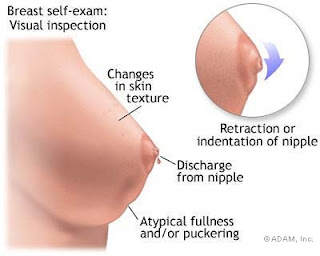
In some cases, however, the first sign of breast cancer is a new lump or mass in the breast that you or your doctor can feel. A lump that is painless, hard, and has uneven edges is more likely to be cancer. But sometimes cancers can be tender, soft, and rounded. So it's important to have anything unusual checked by your doctor.

According to the American Cancer Society, any of the following unusual changes in the breast can be a symptom of breast cancer:

swelling of all or part of the breast
skin irritation or dimpling
breast pain
nipple pain or the nipple turning inward
redness, scaliness, or thickening of the nipple or breast skin
a nipple discharge other than breast milk
a lump in the underarm area
These changes also can be signs of less serious conditions that are not cancerous, such as an infection or a cyst. It’s important to get any breast changes checked out promptly by a doctor.

In the following posts , you can learn about:

Understanding Breast Cancer

How breast cancer happens, how it progresses, the stages, and a look at risk factors.
Screening and Testing
The tests used for screening, diagnosis, and monitoring, including mammograms, ultrasound, MRI, CAT scans, PET scans, and more.

Types of Breast Cancer

The different types of breast cancer, including ductal carcinoma in situ (DCIS), invasive ductal carcinoma (IDC), invasive lobular carcinoma (ILC), inflammatory breast cancer, male breast cancer, recurrent breast cancer, metastatic breast cancer, and more.

Your Diagnosis

The characteristics of the cancer — featured on your pathology report — that might affect your treatment plan, including size, stage, lymph node status, hormone receptor status, and more.